(no subject)

Dec. 19th, 2025 08:39 pm
alicebentley: (Default)
[personal profile] alicebentley
That work thing I didn't much talk about: sales aren't as strong as they need to be at The Bone Factory, and as part of dealing with that they have pulled me out of my beloved Assembly area and put me on Shipping Support. Specifically, running the ink jet printer.

I don't mind doing it, and it's certainly a critical path task, but it's rather a step down from my previous position. Also, sometime in January they're going to drop me to part time. I'm guessing 20 hrs/week but they won't say and I suspect they don't know yet.

It will be a hit in the wallet, and a blow to my illusions of being a useful and valuable member of my work team. But I've never forgotten that Life Is Change, and I'll help it all come around right eventually.

Once I'm on part time I will likely poke around town for an additional part time job. There are a couple places I think likely. But I'm going to put that all aside until I return from my upcoming Friends and Family Adventure, which starts next week (flying to Chicago Wednesday evening) and runs through until past New Years (taking the train from Kalamazoo MI to Chicago IL, then Portland OR, then Seattle WA. That will be a three day trip and I'll be bringing lots of ebooks and audio books.

For 2026 I plan to log all the books I read and/or listen to, even the ones I DNF (which happens rather a lot I'm sad to say).

The Best Option

Dec. 19th, 2025 08:29 pm
lovelyangel: (Kuroyukihime Happy)
[personal profile] lovelyangel
I don’t remember what I was doing and where I learned that there was a Very Special Edition of Only Bad Options by Jennifer Estep being released this month. I was not on Ms. Estep’s mailing list, so I missed any announcements regarding this book in November and December. (I’m definitely on the mailing list now.)

Whatever I saw was enough to make me visit her site and look at order details. I saw an order deadline of December 12. I happened upon all this on the afternoon of December 10. Not even time enough to overthink this – I submitted an order immediately.

The next day I received very polite correspondence from Ms. Estep that my order form had lost my mailing address – and requested I provide the information – which I did. Also I saw I could request custom text to go with her autograph. I was too befuddled to come up with anything cute (you know... something like... To Amy, forever a Vesper fangirl...) – and I was fine with the default.

Anyway, the order was placed under the wire, and the package was shipped by Saturday (according to tracker emails) – arriving here yesterday, Thursday, December 18. I eagerly opened the box.

This was certainly a case of underpromise / overdeliver. Cradled in a swath of sparkly foil wrap was the book fully and tidily wrapped in paper gift wrap. This gift was for me, so I unwrapped the book – which is beautiful. I’m delighted to have a true hardbound book, far superior to the hardcover trade paperbacks that I own for the Galactic Bonds series. (I don’t trust the binding on those books.) Plus, it’s autographed.

Only Bad Options (Special Edition) by Jennifer Estep

The overdeliver part is all the extras that were included with the book – coloring bookmarks along with a box of crayons to color them with. A pen and notepad. Cute stickers and metallic decorations. And a handwritten card from Jennifer herself. It’s like a little surprise treasure box. Above and beyond!

I’ve lived long enough to know to listen to the Universe – and when serendipity presents an opportunity just before a deadline, I know to accept the sign. As always, I am a very lucky person. There are no coincidences. I would have been sad to have learned about this book after the fact. The new book has a home in the new bookwall.

Previous Galactic Bonds References
Link Salad (Jan 2023)
Tsundoku Winter (Mar 2023)
Tsundoku July (Jul 2023)
One More for the Pile (Mar 2024)
Love in Tsundoku (Mar 2024)
Tsundoku Winter (Mar 2025)
Tsundoku Reset (Oct 2025)

New Worlds: In the Dark Ages

Dec. 19th, 2025 09:07 am
swan_tower: (Default)
[personal profile] swan_tower
Thanks to my research for the upcoming Sea Beyond duology, I became aware of something called the "Alexander Romance." Like Arthuriana, this is less a text than a genre, an assortment of tales about how Alexander quested for the Water of Life, slew a dragon, journeyed to the bottom of the ocean, and so forth.

Yes, that Alexander. The Great.

How the heck did we wind up with an entire genre of stories about a Macedonian conquerer who died young that bear so little resemblance to the historical reality?

The answer is that history is much easier to forget than we think nowadays, with our easily mass-produced books. However much you want to lament "those who do not remember the past" etc., we know vastly more about it than any prior age could even aspire to. The legendary tales about Alexander arose quite soon after his death, but by the medieval period, his actual life was largely forgotten; more factual texts were not rediscovered and disseminated until the Renaissance. So for quite a while there, the legends were basically all we had.

Historians tend to not like the phrase "the Dark Ages" anymore, and for good reason. It creates assumptions about what life was like -- nasty, brutish, and short -- that turn out to not really match the reality. But while plenty of people have indeed used that term to contrast with the "light" brought by the Renaissance, one of the men responsible for popularizing it (Cardinal Cesare Baronio, in the sixteenth century) meant it as a statement on the lack of records: to him, the Middle Ages were "dark" because we could not see into them. The massive drop in surviving records had cast that era into shadow.

How do those records get lost? Year Two went into the perils that different writing materials and formats are vulnerable to; those in turn affect the preservation of historical knowledge. Papyrus texts have to be recopied regularly if they're to survive in most environments, so anything that disrupts the supply of materials or the labor available to do that recopying means that dozens, hundreds, even thousands of texts will just . . . go away. Parchment is vastly more durable, but it's also very expensive, and so it tended to get recycled: scrape off the existing text, write on it again, and unless you were lazy enough in your scraping that the old words can still be read -- think of a poorly erased blackboard or whiteboard -- later people will need chemical assistance (very destructive) or high-tech photography to see what you got rid of.

And when your supply of written texts shrinks, it tends to go hand in hand with the literacy rate dropping. So even if you have a record of some historical event, how many people have read it? Just because a thing gets preserved doesn't mean the information it contains will be widely disseminated. That is likely to be the domain of specialists -- if them! Maybe it just sits on a shelf or in a box, completely untouched.

Mind you, written records are not the only way of remembering the past. Oral accounts can be astonishingly precise, even over a period of hundreds or thousands of years! But that tends to be true mostly in societies that are wholly oral, without any tradition of books. On an individual level, we have abundant research showing that parts of the brain which don't see intensive use tend to atrophy; if you don't exercise your memory on a daily basis, you will have a poorer memory than someone who lives without writing, let alone a smartphone. On a societal level, you need training and support for the lorekeepers, so they act as a verification check on each other's accurate recitation. Without that, the stories will drift over time, much like the Alexander Romance has done.

And regardless of whether history is preserved orally or on the page, cultural factors are going to shape what history gets preserved. When the fall of the Western Roman Empire changed the landscape of European letters, the Church was left as the main champion of written records. Were they going to invest their limited time and resources into salvaging the personal letters of ordinary Greeks and Romans? Definitely not. Some plays and other literary works got recopied; others were lost forever. The same was true of histories and works of philosophy. A thousand judgment calls got made, and anything which supported the needs and values of the society of the time was more likely to make the cut, while anything deemed wrong-headed or shocking was more likely to fall by the wayside.

The result is that before the advent of the printing press -- and even for some time after it -- the average person would be astoundingly ignorant of any history outside living memory. They might know some names or events, but can they accurately link those up with dates? Their knowledge would be equivalent to my understanding of the American Civil War amounting to "there was a Great Rebellion in the days of Good President Abe, who was most treacherously murdered by . . . I dunno, somebody."

In fact, there might be several different "somebodies" depending on who's telling the tale. John Wilkes Booth might live on as a byword for an assassin -- imagine if "booth" became the general term for a murderer -- but it's equally possible that some people would tell a tale where Lincoln was murdered by an actor, others where a soldier was responsible, and did that happen at a theatre or at his house? (Booth originally planned to kidnap Lincoln from the latter; that detail might get interpolated into the memory of the assassination.) Or it gets mixed up somehow with Gettysburg, and Lincoln is shot right after giving his famous speech, because all the famous bits have been collapsed together.

Even today, there are plenty of Americans who would probably be hard-pressed to correctly name the start and end dates of our Civil War; I'm not trying to claim that the availability of historical information means we all know it in accurate detail. But at least the information is there, and characters who need to know it can find it. Furthermore, our knowledge is expanding all the time, thanks to archaeology and the recovery of forgotten or erased documents. Now and in the future, the challenge tends to lie more in the ability to sift through a mountain of data to find what you need, and in the arguments over how that data should be interpreted.

But in any story modeled on an earlier kind of society, I roll my eyes when characters are easily able to learn what happened six hundred years ago, and moreover the story they get is one hundred percent correct. That just ain't how it goes. The past is dark, and when you shine a light into its depths, you might get twelve different reflections bouncing back at you, as competing narratives each remember those events in variable ways.

For a writer, though, I don't think that's a bug. It's a feature. Let your characters struggle with this challenge! Muddy the waters with contradictory accounts! If you want your readers to know the "real" story, write that as a bonus for your website or a standalone piece of related fiction. Then you get to have your cake and eat it, too.

Patreon banner saying "This post is brought to you by my imaginative backers at Patreon. To join their ranks, click here!"

(originally posted at Swan Tower: https://is.gd/Tnyzpz)

Go and Stop

Dec. 18th, 2025 07:23 pm
lovelyangel: (Rakka Angel)
[personal profile] lovelyangel
Surprising but welcome news – a green light is lit for a Second Anime Season of Yona of the Dawn – more than 10 years after the first season. The manga is just now ending and will hit 47 volumes. I can’t say I’m really excited about the anime; I’m currently more interested in how the story ends.

Speaking of story ends... after ignoring the series all season, yesterday I binge-watched the last 10 episodes of My Hero Academia. The long series ended about as I expected. Except for Ochaco getting shortchanged (as she has throughout the series), I’m satisfied but not delighted with the ending. I don’t think I need to watch this series again.

chocolate

Dec. 18th, 2025 06:20 pm
redbird: closeup of me drinking tea, in a friend's kitchen (Default)
[personal profile] redbird
No, I did not spend all the money in my wallet on chocolate*, but I treated us to a box of chocolates from Serenade, the chocolatier in Brookline with a wide selection of vegan chocolates.

I took the bus to Brookline Village, walked a little extra because I was wrong about which bus stop to use, walked into the shop, and asked for a one-pound box.

I bought two vegan caramels, which Adrian had asked for; I'd have gotten more, but I wasn't sure what she or Cattitude think of sea salt caramel. Just for myself, I got six dairy truffles, three lemon and three lime. The rest was a few (vegan) chocolate creams, and a lot of chocolate-dipped fruit and nuts, including several of their excellent chocolate covered plums, a candy I haven't seen anywhere else.

I came home via Trader Joe's, where I bought fruit, a bell pepper, hummus, pre-cooked chicken sausages, a carton of chocolate ice cream, and a box of frozen vanilla and chocolate macarons.

Even counting the chocolate part of the groceries, I would have had money left from the $79 that happens to be how much cash is in my wallet right now. That's a pretty arbitrary metric, since I don't always have the same amount of cash (I do make a point of having some, because cash still comes in handy sometimes).

*see yesterday's post

(no subject)

Dec. 17th, 2025 12:11 pm
[personal profile] martianmooncrab
every now and then you see something right, so the other night I was waiting at a red light, and I watched some testosterone car make their left turn and right behind them was a city cop. Oh, yeah, the t car came thru the intersection hit the straight and gunned it. Oh its 30mph there, and the cop was right behind them, and before the next traffic light, the disco lit off... sigh.. so many times you see someone being stupid and they keep on going, well... it was gratifying.

I get my van back monday, its been up and down, and they did find a broken part and had to wait for the replacement to come in. they painting it at the moment.

cardiology on friday, niece on saturday to see Wicked, and family xmas on sunday.

pulmonology says my lung sparkle is caused by my reflux issues, saw speech therapist last week and she agrees, she scoped my vocal bits... which I do not recommend, it gave me flashbacks to covid testing... because they run the scope up the old nose and down the back of your throat. gag.

pulmonology was such a tap dancing moment, they were disavowing the spot on my lung, they blamed the old mammaries (hah! already had that checked!) and now they saying its heart tissue. Which I will address on friday. After trying to schedule me a year out for my next appt, its now on for March, since I told them I wasnt comfortable with waiting a year.

the shots for the psoraisis are still kicking my ass, but, my ass isnt as scaley and its slowly healing up, I still shedding skin but its not like I am molting full time. Still itchy as hell, but, not 24/7 ... slowly slowly slowly, but improving.

my sleep study ended up working. I do stop breathing at least 12 times an hour which is double normal. I even got 8. hours of sleep clocked in, and I thought I got only 5. I must have a very active brain because I swear I woke up at least once. Now I wait for my primary doc to chime in.

ouhmmm.. and my A1C had come down! not down enough, but, still... its single digits now.

lots of things to do, but not whipping up enough ambition.

Solstice is coming!

inherited IRA, part I don't even know

Dec. 17th, 2025 11:37 am
redbird: closeup of me drinking tea, in a friend's kitchen (Default)
[personal profile] redbird
I just made another call to Fidelity (investment company) about the inherited IRA. They are going to generate a "Letter of Acceptance" form and send it to BNY, and then (I hope) we will have the money out of my mother's name before the end of the year, which will please my brother as executor of the estate.

The bit where the advisor told me to search for something on the website, and that led to an irrelevant form, was not encouraging--I think he overheard me saying to [personal profile] cattitude that I'm starting to understand why people hide their money under mattresses.

Jonathan said this should take 1-2 business days at the BNY end, and that he'll let me know when the transfer has gone through.

I am not going to spend all my money on chocolate, probably not even all the money currently in my wallet, but it's tempting.

Yuletide progress: it is posted!

Dec. 17th, 2025 04:28 am
elisem: (Default)
[personal profile] elisem
 I have met the deadline and posted the thing! Now we just have the week between today and Reveal Day, also known as "the week where I find all the hidden typos and fix them." Main Collection Reveal Day for the fics is the 24th, and is followed by Author Reveals on January 1.

This year was more work than previous years, for a very particular reason. I got COVID for the first time in October, and while I got very lucky (Paxlovid turns out to work for me, yay!), I am so easily drained to exhaustion, by pretty much anything including brain work, which has never been this bad before. Also, I'm used to multitasking, and hoo boy do I need different strategies and approaches now.

I'm planning for a very long recuperation, since it looks like that's the smart way to go. But here we are, and today is a milestone day. The story is a story, and it's posted, and now I can catch up a little on my Etsy shop (I hardly posted anything new while writing) and my eBay offers (I'm selling most of a half-century's worth of queer and related subjects library, since I'm not a working journalist any more and somebody really should get use out of these books and periodicals).

It's been a long time. I had forgotten the peculiar satisfaction that comes with meeting a deadline.

y ahora . . . ¡Pillaje de palabras!

Dec. 16th, 2025 11:31 am
swan_tower: (*writing)
[personal profile] swan_tower
I suppose it's fitting that a poem about language should attract some attention from translators after it wins the Hugo Award, but I didn't see it coming.

Cuentos para Algernon has published my work once before, a translation of "Waiting for Beauty" as "Esperando a que Bella . . .". A little while ago, Marcheto came back to ask if she could also translate "A War of Words" -- a query that left me staring in a bit of surprise at my computer screen, because I'd legit never thought anybody would be interested in translating my poetry. The result went live today, as "Pillaje de palabras."

Nor will that be the only one! There's also a Romanian translation in the works!

But this one is a little special, because as you may recall, I spent 2024 bludgeoning myself up to something like reading proficiency in Spanish so I could do broader research for the Sea Beyond. When Marcheto asked to translate "Waiting for Beauty," I could kinda read the result, but mostly because I already knew what it said. This time around, I was actually in a position to collaborate more actively with her: the translation is Marcheto's, but I read a draft and gave feedback, suggesting some slight alterations to bring it more in line with my original intent.

This was a fascinating process. Every translator knows there are always choices to make -- and they're not right or wrong choices, just questions of priority and style. For example: if you were to translate the title for its literal meaning, it would be "Una guerra de palabras," and that's what Marcheto originally went with. She proposed "Pillaje de palabras" as an alternative, though, because I had mentioned at the outset that I wanted to preserve the elements of alliteration within the poem if it could be done naturally in Spanish. It's a less direct translation, but one that emphasizes the poetic quality of the title.

Or take the places where languages can't quite re-create each other's effects. Marcheto originally translated "raid" as "incursión," which is of course completely reasonable. In reading the Spanish draft, though, I became aware of something I'd done entirely on reflex when writing the poem: the text leans heavily toward short, simple, Germanic-derived words, rather than Latinate ones, because the former tend to sound more direct and harsh than the latter. What do you do, though, when the language of the translation is Latinate through and through? I suggested, and Marcheto agreed with, "ataque" instead, which sounds a little sharper (and assonates with "arrebatada" to boot). The same happened with "existe una palabra" becoming "hay una palabra": she said, and I believe her, that "existe" doesn't sound at all high-flown to Spanish speakers, the way that "a word exists" sounds fancier in English than "there's a word" . . . but "hay una" flows off the tongue a little more smoothly, so that's what we went with.

All told, my suggested alterations were few and minor. (There were also a couple she stood her ground on -- which was entirely fair; she's the native speaker!) But it was a really intriguing process, the first time I've been able to meaningfully contribute to the translation of my own work. It makes you think a lot about what you did and why you did it, and if you have to choose between two different priorities, which one matters to you more.

If you read Spanish, I'd be delighted to hear your thoughts on the translation!

Books read, early December

Dec. 15th, 2025 08:41 pm
mrissa: (Default)
[personal profile] mrissa
 

Eleanor Barraclough, Embers of the Hands: Hidden Histories of the Viking Age. Material goods/archaeological evidence in the study of this period. It's slightly awkwardly balanced in terms of who the audience is--I have a hard time that people who need this much exposition about the era will pick up a book this specifically materially detailed--but not upsetting in that regard.

Elizabeth Bear, Hell and Earth. Reread. Returning to my reread of this series in time to still have all the memories of what's been going on with Christopher Marlowe and William Shakespeare and their connections to faerie realms; as the second half of a larger story, it goes hard toward consequence and ramification from the very start of the volume.

Jerome Blum, In the Beginning: The Advent of the Modern Age: Europe in the 1840s. I feel like this is trying for more than it achieves. It goes into chapters about Romanticism and the advent of science and some other things, and then there's a second section with chapters about major empires. But what it doesn't do is actually talk about Europe in this period--it's fairly easy to find material about England, about France, even about Russia, but there's nothing here about Portugal or Greece or Sweden. It's not a volume I'm going to keep on the shelves for the delightful tidbits, because it's not a tidbit-rich book. Also some of the language is '90s standard rather than contemporary. So: fine if this is what you have but I think you can do better.

Ashley Dawson, Environmentalism From Below: How Global People's Movements Are Leading the Fight for Our Planet. Good ground-up Third World environmentalism thoughts.

Victoria Dickenson, Berries. One of my friends said, "a book about berries, Marissa would love that!" and she was absolutely right. It is lushly illustrated, it is random facts about berries, I am here for it.

Emily Falk, What We Value: The Neuroscience of Choice and Change. Interesting thoughts on working around one's particular brain processes--the third "c" that did not make the title is "connection," and there's a lot about how that can be used to live lives closer to our own values.

Margaret Frazer, Heretical Murder. Kindle. One of the short stories, and possibly the least satisfying one of hers I've read so far: there's just not room for questions, uncertainty, or even a very human take on the life experiences of heretics in this milieu. Oh well, can't win them all.

Jonathan Healey, The Blood in Winter: England on the Brink of Civil War, 1642. If you're an English Civil War nerd, this book on the lead-up to it will be useful to you. I am. It is.

T. Kingfisher, Snake-Eater. A near-future desert fantasy that was creepy and exciting and warm in all the right spots. This is one of Kingfisher's really good ones. Also Copper dog is a really good dog--I mean of course a good dog but also a well-written dog, a dog written by someone who has observed dogs acutely.

Olivia Laing, The Garden Against Time: In Search of a Common Paradise. Lyrical writing about gardening in the face of more than one apocalypse at the same time. Laing loves many of the same reference points as I do, in life, in literature, and in botany, so I found this a warmly congenial book.

L.R. Lam, Pantomime. This is very much the first volume in a series; its ending is a midpoint rather than an ending per se. It's a circus fantasy with an intersex and nonbinary protagonist, and it was written just over a decade ago--this is one of the books that had to exist for people to be doing the things with intersex and/or nonbinary characters that they're able to not only write but get published now.

Ada Limón, Startlement: New and Selected Poems. Glorious. Some favorites from past collections and some searing new work, absolutely a good combination, would make a good present especially for someone who doesn't have the prior collections.

Daniel Little, Confronting Evil in History. Kindle. This is a short monograph about philosophy of history/historiography, and why history/historians have to grapple with the problem of evil. I feel like if you're really interested in this topic there are longer, more thorough handlings of it, but it was fine.

Robert MacFarlane, Is a River Alive? Really good analysis of how we parse things as alive and having rights, and also how riverine biology, ecology, social issues are being handled. Personal to the right degree, balanced with broader information, highly recommended.

Lars Mytting, The Bell in the Lake and The Reindeer Hunters. The first two in a series of Norwegian historical fiction, not more cheerful than that genre generally is but more...active? relentless? I really like this, they're gorgeous, but people will die sad deaths, that's how this stuff does, it's just as well that I'm taking a break before reading the next one because too much of it can make me gloomy but just the right amount is delightful. The symbolism of the stave church and its bells and weaving and all the weight of rural Norway hits in all the right ways for me.

A.E. Osworth, Awakened. This queer millennial contemporary fantasy is not rep of me, it's rep of the people I'm standing next to a lot of the time, and that's powerful in its own way. Many of you are that person. This does things with magic/witch community that feel very true and solid, and it's a fun read.

Lev A.C. Rosen, Mirage City. The latest in the Evander Mills mysteries. This one takes Andy to Los Angeles and his childhood home, in pursuit of missing (queer) persons. Some of them turn out to be perfectly well, some of them...a great deal less so...but the B-plot was focused on Andy's relationship with his mother, whose job turns out to be something he didn't know about--and will have trouble living with. The last line of the book made me burst into tears in a good way, but in general this is a series that has a lot of historical queer peril, and if that's something that's going to make you more unhappy than otherwise, maybe wait until you're in a different place to try them. I think they continue to stand reasonably well alone.

William Shakespeare, King Lear. Reread. Okay, so at some point in early October I earnestly wrote "reread King Lear" on my to-do list for reasons that seemed tolerably clear to me at the time. Things on the list tend to get done. Somewhere in the last two months I forgot why this was supposed to get done. If there's a project it's supposed to inform, reading it has not helped me figure out which project that is. I'm not mad that I reread it, it still has the bits that are appalling in the most interesting ways, but...well. A mystery forever I suppose.

Martha Wells, Platform Decay. Discussed elsewhere.

Platform Decay, by Martha Wells

Dec. 15th, 2025 08:41 pm
mrissa: (Default)
[personal profile] mrissa
 

Review copy provided by the publisher.

I got this in the mail today and immediately read it. Now, yes, it is December and my TBR is perilously small. But also: new Murderbot! Yay! Still delighted to see more of this series.

In this episode: Murderbot has installed code that allows/requires "emotion checks" periodically, so we get to see the self-awareness process evolve with that (and sometimes devolve...). Murderbot is also assisting with the extraction of several humans, including juveniles and an elder. Juvenile humans do all sorts of things that alarm, annoy, and in some cases terrify Murderbot. This is all to the good.

("Terrified" is never the response to an emotion check. Obviously. Like the kid in The Princess Bride, Murderbot is sometimes a bit concerned, that's all. Definitely only a bit concerned.)

Unfamiliar systems, unfamiliar humans, what else could be called for here...oh, wait, is it the consequences of Murderbot's own actions? WELP. Lots of fun. Still recommend. Don't start here, it's mid-ramification.

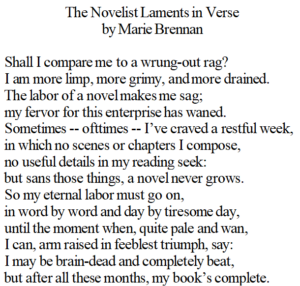
"The Novelist Laments in Verse"

Dec. 15th, 2025 06:24 pm
swan_tower: (*writing)
[personal profile] swan_tower
A screencap of a sonnet titled "The Novelist Laments in Verse" by Marie Brennan:Shall I compare me to a wrung-out rag?I am more limp, more grimy, and more drained.The labor of a novel makes me sag;my fervor for this enterprise has waned.Sometimes -- ofttimes -- I’ve craved a restful week,in which no scenes or chapters I compose,no useful details in my reading seek:but sans those things, a novel never grows.So my eternal labor must go on,in word by word and day by tiresome day,until the moment when, quite pale and wan,I can, arm raised in feeblest triumph, say:I may be brain-dead and completely beat,but after all these months, my book’s complete.

(I have finished a draft of The Worst Monk in Omnu, just in time to kick back for the holidays!)

Yuletide progress

Dec. 15th, 2025 12:19 pm
elisem: (Default)
[personal profile] elisem
 Yes, I am cutting it close. I blame getting COVID Halloween week, and having to rest like a potato. Which I am still doing, but I have advanced to the stage of literate potato. I hope. Because this thing is due in, what, fifty-some hours?

Anyhow, I came here to post that I have reached the milestone in writing the current draft where I just reread a section and said out loud, "OK, so there are actually a few bits in here that aren't completely shitful." Like, it's a known milestone. So that's encouraging.

Onward.

(Yes, that's why nothing new is in the shop this week. I have been on a schedule of sleep, write, sleep, write, with meds and basic necessities in there as needed. Not enough oomph left to photograph new work and still write and edit. Potato has limited spoonage here. But Potato is too proud to default on Yuletide. Please point people to go shop in the Etsy shop, though. Potato is fretting about this being a rough December for so many artists. Oh! Remind me to tell you about Boxing Day, which is going to be completely bonkers in a new way.)

It's been 53 years

Dec. 14th, 2025 01:14 pm
kengr: (Default)
[personal profile] kengr
Dec 14, 1972. At 2:54 pm PST, the last humans departed from the lunar surface.

Bush vs. Gore vid

Dec. 14th, 2025 05:59 am
brainwane: My smiling face, including a small gold bindi (Default)
[personal profile] brainwane
Happened across this Bluesky post embedding a TikTok of a vid about Al Gore "losing" the 2000 election to George W. Bush, set to a Sabrina Carpenter song. Enjoyed and wanted to share.
elisem: (Default)
[personal profile] elisem
 Um.

I tried to write an intro for this, but all I can do is gesture incoherently. No, I wasn't a Baldy, I wasn't a skinhead, but the milieu affected my life for Reasons.  If you watch this documentary it may give you a better understanding of (some of) what made Minneapolis in the 80s what it was. Or maybe you were there too, and this will be an interesting tour of byegone days.

I really want to get together and share stories of those times. For now, here, have a pretty good documentary:

https://www.youtube.com/watch?app=desktop&v=8BSDZ1DIEIQ

Exactly what we needed

Dec. 13th, 2025 05:33 am
mrissa: (Default)
[personal profile] mrissa
 

We've all heard it a million times: baking is precise and cooking is loose. Cooking is jazz, baking is classical. Cooking has room to improvise, but with baking you have to follow the recipe to the letter.

This is, of course, nonsense. For one thing, you can't control every variable every time. If baking required everything to be utterly precise, it would never work, because air temperature, pressure, and humidity all vary; you have to be able to work around those major variables. If it was true, you'd never see experienced bread bakers frown and throw another handful (or three) into the recipe. And most importantly, if this was true......how would we ever get new baked goods?

I think this is a mistake we make too often when we're thinking about bringing light into dark times for each other. We think of it has having to be precise and perfect for it to work. If we're not winning every struggle, we must be doing something wrong and should just quit. If we can't come up with the perfect phrasing to offer comfort to worried or grieving friends and neighbors, why even try? Maybe tomorrow we'll be warm and witty and precisely right. Or someone else can do it. Surely someone else has the right answer, and we can just use that.

So yeah, the lussekatter--you know what day it is--rose despite the plummeting temperature (and with it the plummeting humidity, oh physics why do you do us like this). They rose and rose and rose. Friends, they are mammoths. They are lusselejon this year. I forgot the egg glaze--I told you last year that I shouldn't mention that remembering it was unusual, and ope, it was an omen, I did not put egg wash on. They are still great. They are still amazing. What they are not--what they don't have to be--is perfect.

Last week one of my friends wrote to me to say that she'd made calzones but they'd turned out denser than usual. And you know what I thought? I thought, "Ooh, her family got calzones, I should make calzones one of these days!" And not in the "I'd do it better than that loser" way, either. Just: yay homemade calzones, what a treat. I watched her doing it. I remembered that I can do it too. Dense or not. Egg washed or not. Perfect or--let's be real, perfect isn't available, what we have is imperfect, and it turns out that's what we need. Lighting one imperfect candle from another, all down the chain of us, until the light returns.

2024: https://marissalingen.com/blog/?p=4078

2023: https://marissalingen.com/blog/?p=3875

2022: https://marissalingen.com/blog/?p=3654

2021: https://marissalingen.com/blog/?p=3366

2020: https://marissalingen.com/blog/?p=2953

2019: https://marissalingen.com/blog/?p=2654

2018: https://marissalingen.com/blog/?p=2376

2017: https://marissalingen.com/blog/?p=1995

2016: https://marissalingen.com/blog/?p=1566

2015: https://marissalingen.com/blog/?p=1141

2014: https://marissalingen.com/blog/?p=659

2013: https://marissalingen.com/blog/?p=260

2012: https://mrissa.dreamwidth.org/840172.html

2011: https://mrissa.dreamwidth.org/796053.html

2010: https://mrissa.dreamwidth.org/749157.html

2009: https://mrissa.dreamwidth.org/686911.html

2008: https://mrissa.dreamwidth.org/594595.html

2007: https://mrissa.dreamwidth.org/2007/12/12/ and https://mrissa.dreamwidth.org/502729.html

2006: https://mrissa.dreamwidth.org/380798.html — the post that started it all! Lots more about the process and my own personal lussekatt philosophy here!...oh hey, this is the twentieth year I've posted about this. Huh. Huh. Well, isn't that a thing.

SARAH STEPHENS IS NOT YOUR AI GRANDMA

Dec. 12th, 2025 05:35 pm
jreynoldsward: (Default)
[personal profile] jreynoldsward

Some thoughts about digital personalities in my work

(self-indulgent blather about my take on artificial digital beings, as I’ve written them)

I’ve been watching the latest AI developments with a somewhat…oh, what word do I want? Not jaded, not cynical, but definitely somewhere in between. Especially when I start reading about “AI Grandmas” and the use of that tech to speak to long-dead relatives. Oh, it’s presented with that same amber glossiness that seems to dominate the worlds of AI visual creations. But…we’re already seeing some of the dark side of these AI creations with reports of self-harm and worse coming from AI “personalities.”

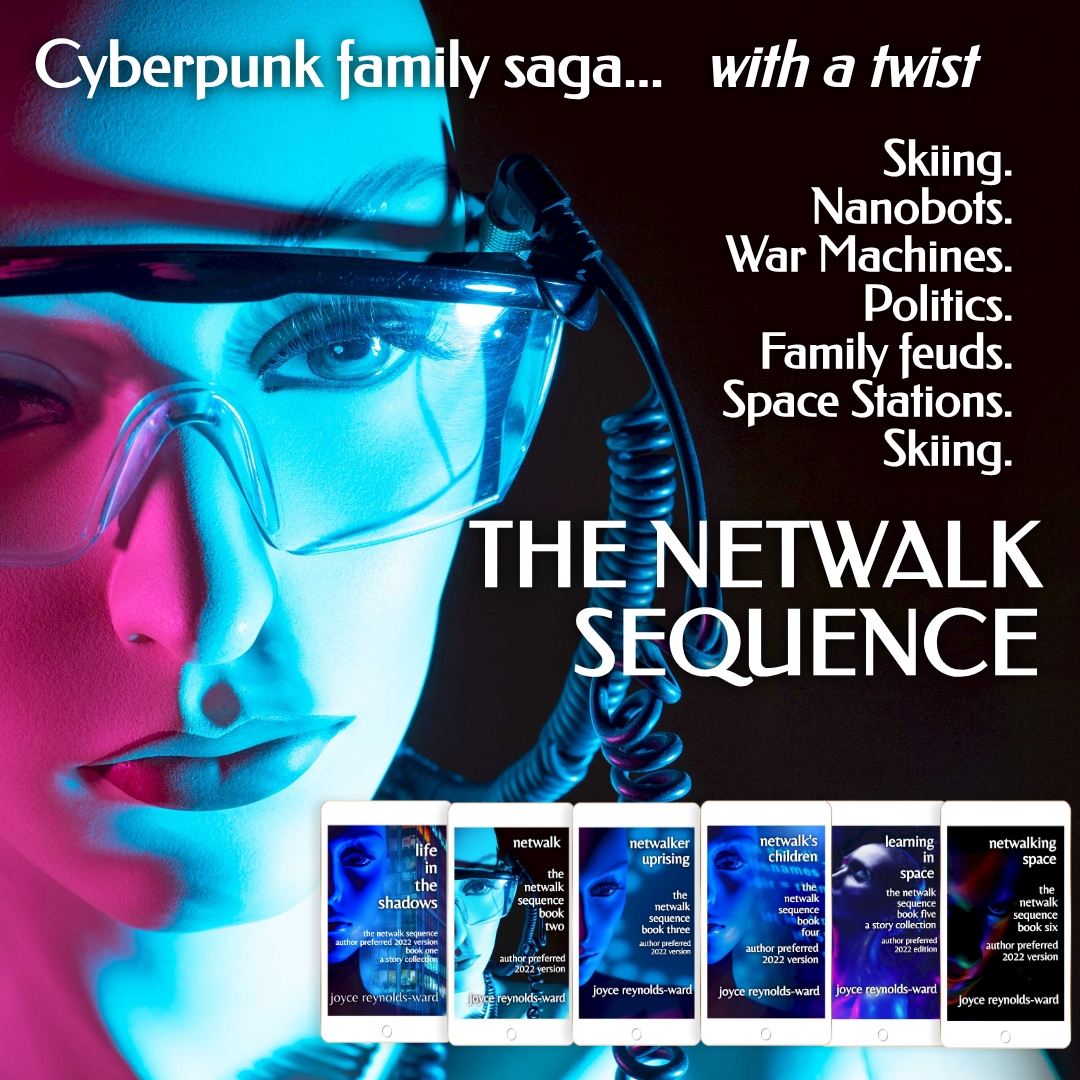
One reason for my attitude is that the creation of self-aware digital personalities is something I’ve somewhat explored in my work, most notably the Netwalk Sequence series and the Martiniere Family Multiverse Saga. In both cases, the tech I explore is already somewhat different from what we are seeing. I don’t go into the nuts and bolts of just how that self-awareness ends up happening (well, a little bit in the Martinieres). But nonetheless, I think this dynamic of what that really looks like is something very much overlooked in the current hype around “preserving the memories of your loved ones” in order to recreate them in a digital simulation. I can oh-so-easily see how it could turn bad.

What happens if AI Grandma is toxic? Or if AI Grandma develops sufficient self-awareness to start meddling in the affairs of her descendants? It’s entirely possible. And while AI Grandma might not have the ability with current tech to really muck up her descendants’ banking and financial history…there’s still a lot of damage she can do to living beings.

The Netwalk Sequence was my first exploration of just what the problems with a separate digital personality creation could end up being. I started building the Netwalk Sequence world back in the ‘90s, when digital personality uploads were somewhat the fashion in fiction and in theory.

My base assumption was that digital personalities could completely upload to the internet upon their death. In that world it’s entirely possible to be a complete personality online, with full body immersion, using the mechanism of a highly sophisticated wireless communication chip implant called Netwalk. Uploading came later, in the midst of a dramatic political struggle where an older leader—Sarah Stephens—uploaded upon her death and began to stalk and attack her opponents. The new development was called Netwalk, and the uploaded personalities called Netwalkers.

A restraint that I created in the Netwalk universe was that Netwalkers would go insane and turn predatory on living beings if completely cut off from sensory inputs. They would attack alive users of Netwalk in order to gain sensory exposures and recharge themselves—as well as fulfilling agendas and settling resentments that hadn’t been dealt with in life. In some cases this would end up as possession of the living being by the Netwalker. As a result, with the exception of a handful of rogues, Netwalkers ended up being tied to a living host, most specifically that host’s Netwalk chip. In the Sequence, we see is how this plays out within one powerful family, the creators and controllers of this technology. With some other dynamics thrown in as well—the control of a war machine of unknown origin which has some influence on the development of the original Netwalk, plus intensely weird family history that involves a lot of infighting and struggles over who controls what.

There’s no grudge like a family grudge, shall we say?

In the Martiniere Multiverse, I postulate something closer to our current concept of the “AI Grandma,” where videos and recordings lead to the creation of digital thought clones. Thought clone appearances in the Martiniere Multiverse aren’t constrained to computers and devices, however, and they can hop universes. This is somewhat connected to a magical Fae origin which is tied to a computer worm that can also skip through assorted multiverses.

The Martiniere digital thought clones (digis for short) differ from Netwalker personality uploads at death in that they are specifically digital constructs of a once-living personality, and only become activated upon specific actions by a living person who is keyed into the algorithm. The digis are fully aware that they are digital constructs and are not the uploaded personality of the dead person they’re modeled after.

Digis don’t appear in every Martiniere book. To follow their development chronologically in series order, start with The Enduring Legacy, the fourth book of the Martiniere Legacy series. We see Gabriel Martiniere’s first awareness of digis shortly before his death, when he ties the appearance of a dangerously destructive computer worm to specific holes in not just his memory but the memories of his closest family. Gabe takes the first steps to establish the bounds of his digi, with a specific activation algorithm tied to certain family members.

More details about digis and their creations happen in two of the Martiniere Legacy standalones, The Heritage of Michael Martiniere and Justine Fixes Everything: Reflections on Mortality. Heritage shows Gabe’s activation; Justine goes into further complications. However, the most details and the most explicit multiversal version appears in the three books of The Cost of Power: Return, Crucible, and Redemption.

Like Netwalkers, digis are capable of possessing living beings and bending them to their will. There are malign digis and beneficial digis. We only see them in the context of one, powerful family because, in both cases, the artificial entities serve as chess pieces in ongoing family battles. They are obstacles that need to be navigated and overcome by the protagonists.

(Sarah Stephens and Philip Martiniere would probably strongly disagree with me but—nothing says that they are pawns.)

Back in real life, Netwalk is probably not at all feasible, though digis…may be. Current technology doesn’t allow for digis to function the way I wrote them in the Martinieres, but some of the same issues raised by both Netwalk and digis still exist. The news has multiple examples of people being influenced by AI interactions to do harm, whether to themselves or others. Or of people who develop a strong emotional attachment to artificial beings to the detriment of their attachments to living beings.

Rather than the apocalyptic stuff I postulated in the Netwalk and Martiniere books, that’s the real harm in uncritical adoption of the creation of artificial beings. At what point do we slip from a clear awareness that “this is a creation; this is not real” to uncritical acceptance of these creations as real beings?

What happens if we start treating these AI creations as something above and beyond an artificial construct?

What rights will they have as opposed to living humans? Or lack of rights?

What happens if they turn malign, either due to the manner in which they are constructed or due to abusive treatment from living humans? Then what?

All food for thought.

Meanwhile, the artificial beings I created in my own worlds are definitely not your happy-happy AI Grandmas. And at times, I wonder if those imperfect visions of mine may end up reflecting an actual reality.

We shall see.


IRA

Dec. 12th, 2025 06:03 pm
redbird: closeup of me drinking tea, in a friend's kitchen (Default)
[personal profile] redbird
tl;dr still waiting for things

The latest on that inherited IRA is that I got two email messages from Fidelity today, one saying that I needed to do something [unspecified] to transfer the money from BNY, and one saying specifically that BNY had told Fidelity that they, BNY, needed to talk to me.

So, I called BNY, and after various annoyances with their phone tree, talked to someone. He told me that they had no record yet of receiving the form I sent by next-day mail, but that if the form had arrived late Wednesday they might not be scanned until late today or even Monday. Also that once the form is scanned into the BNY system, it may take a few days before they actually transfer the money into my name, which would be necessary in order to move it to Fidelity.

So, I can (and probably will) call Monday to check that the form was in fact been received, but he thinks I should call later in the week, maybe Wednesday, maybe as late as Friday, and ask for my brand-new account number. Once I have that number, I have to fill out appropriate paperwork with Fidelity. *sigh*

I am both annoyed that even paying for next-day delivery, this is taking several days, and thinking that if I hadn’t paid for faster delivery I would be a few days further behind.

The man also said that once the funds are transferred, they will send me an acknowledgement by mail, including the new account number. However, waiting for that to arrive (rather than getting the information by phone) does not seem prudent, given the IRS deadline for the 2025 required minimum distribution.

New Worlds: Getting Philosophical

Dec. 12th, 2025 09:00 am
swan_tower: (Default)
[personal profile] swan_tower
Philosophy is one of those topics where, if you're intending to explore it in detail in your fiction, you probably already know more about it than I do.

The way we talk about it nowadays, it's the exemplar of a rarefied field of study, the province of intellectuals who hardly engage at all with the world around them. As a result, you're unlikely to center philosophy in your worldbuilding unless you know quite a bit about it to begin with (as I, freely confessed, do not). But I do know this much: philosophy is far from disengaged with the world. Indeed, its purpose is to consider why the world works the way it does, how we should engage with it, and other such fundamental and vital questions. So even though my own knowledge is limited, it's worth taking a bit of time to unpack just what philosophy is.

We've touched on parts of it already, because philosophy is not fully separable from other topics. The Year Six essays on sin and salvation? Those got grouped under my broad "religion" header for obvious reasons, but they're also philosophical topics -- specifically the branch known as moral philosophy, which concerns itself with ethical questions like what is good and whether one should weigh intentions or consequences more heavily in evaluating an action. For many people, religion has long been the foundation of moral philosophy . . . though the notion some hold, that a person can't really be moral without faith to enforce it, is utterly without foundation.

Last week's science essay also touched on philosophical matters, because philosophy asks questions like "what do we know and how do we know we know it?" This branch is known as epistemology, or the study of knowledge itself. That revolution in thinking I mentioned before, where the Royal Society said nullius in verba and started testing long-held dogma to see if it was right? That was an epistemological shift, one that declared sense experience and experimental procedure to be the proper basis of knowledge, rather than deference to authority.

Science also ties in with the logic branch of philosophy. How do you know if someone's reasoning is sound? Among specialists, different logical methods often get discussed in very abstract, dry-sounding ways, but we use them all the time in daily life: if you come home to find toilet paper shredded throughout the house and the only living creature who was there is the dog, ergo you conclude the dog is to blame, you're applying logic. Science, medicine, and the law all share the task of looking at the evidence and attempting to formulate an explanation that adequately explains what you see -- or, alternatively, to show that an explanation fails that test. Because, of course, the flip side of logical reasoning is the fallacy: incorrect reasoning, which fails at one or more steps in the chain.

The fourth major branch is metaphysics, and it's the hardest to pin down (thanks in part to the definition changing over time; that's what happens when your field of study has been around for thousands of years). This, I suspect, is what most people think of when they hear the word "philosophy," because metaphysics is the branch asking questions like "why does reality exist?" But here, too, it loops around to touch on other areas of culture, as the beginning and end of the universe fall under this header: religion-themed topics you'll again find in Year Six.

Enough of the abstractions, though. What does this mean for fiction?

Whether you mean it to or not, philosophy is going to soak your fiction, because it soaks your thinking. If your student at magic school decides to experiment with different ways of casting spells to see if what the teacher said is true or not, that's demonstrating a certain epistemological stance, one that says experimental results are the most valid way to answer a question. If your protagonist investigates a mystery and comes up with a theory about what's happening, they're using a specific logical approach. If your villain is pursuing a potentially admirable outcome by really terrible means, they're subscribing to a consequentialist view of ethics, the one commonly shorthanded as "the end justifies the means."

If you don't make a conscious effort to worldbuild the philosophy of your setting, its philosophy is likely to default to yours. Which is not necessarily a bad thing! But it can feel anachronistic or otherwise out of place. If the protagonist in your medieval-esque story approaches questions of knowledge and logic like a modern scientist, they're going to feel a bit like a modern person dressed up in fancy clothes. If the good guys all do that while the bad guys adhere to different philosophical stances, now you're adding an implied moral dimension to the result.

And I suspect that for most stories, it's that ethical dimension of philosophy where this influence becomes most obvious and, at times, problematic. Protagonist does a bad thing, but it gets brushed off because they've got a good heart and that makes it okay? The story is presenting a philosophical argument, whether the author thinks of it that way or not. When the chips are down and a character has to make a hard decision, which way do they jump? Will they bend or break a principle to help someone in need? Will they sacrifice their own desires for the sake of upholding that principle? This is the stuff of deep personal drama, and simply recognizing it as such -- and thinking about what stances the various answers would express -- can result in more powerful stories, rather than simple ones where the supposed hard choice is really a no-brainer.

But especially on that ethical front, it's going to be difficult to write a story that endorses a philosophy you, the author, do not support. Deontology, for example, is the field that looks at ethics from the perspective of obedience to rules . . . and for many of us, that rapidly leads to "lawful evil" territory. We'd have a hard time writing a sincere story in which the protagonist virtuously obeys a terrible order because their duty requires it -- not as anything other than a tragic ending, anyway. It could be the basis of a villain or an antagonistic society, though, and in fact we often deploy these elements in exactly that fashion.

So even if you don't have a degree in philosophy, just dabbling your toes in the shallow end of that ocean-sized pool can help you become more aware of what message your worldbuilding and plot are sending. And that, I think, is worth it!

Patreon banner saying "This post is brought to you by my imaginative backers at Patreon. To join their ranks, click here!"

(originally posted at Swan Tower: https://is.gd/fDGUFl)